
Institutional Collaborators and Supported Actors
This section will help you distinguish between two related but different aspects of our annual reporting:
The IP Appendix, which lists key institutional collaborators in a structured format, and
The Performance Indicator reporting, where we report on actors that have been supported or strengthened through the project.
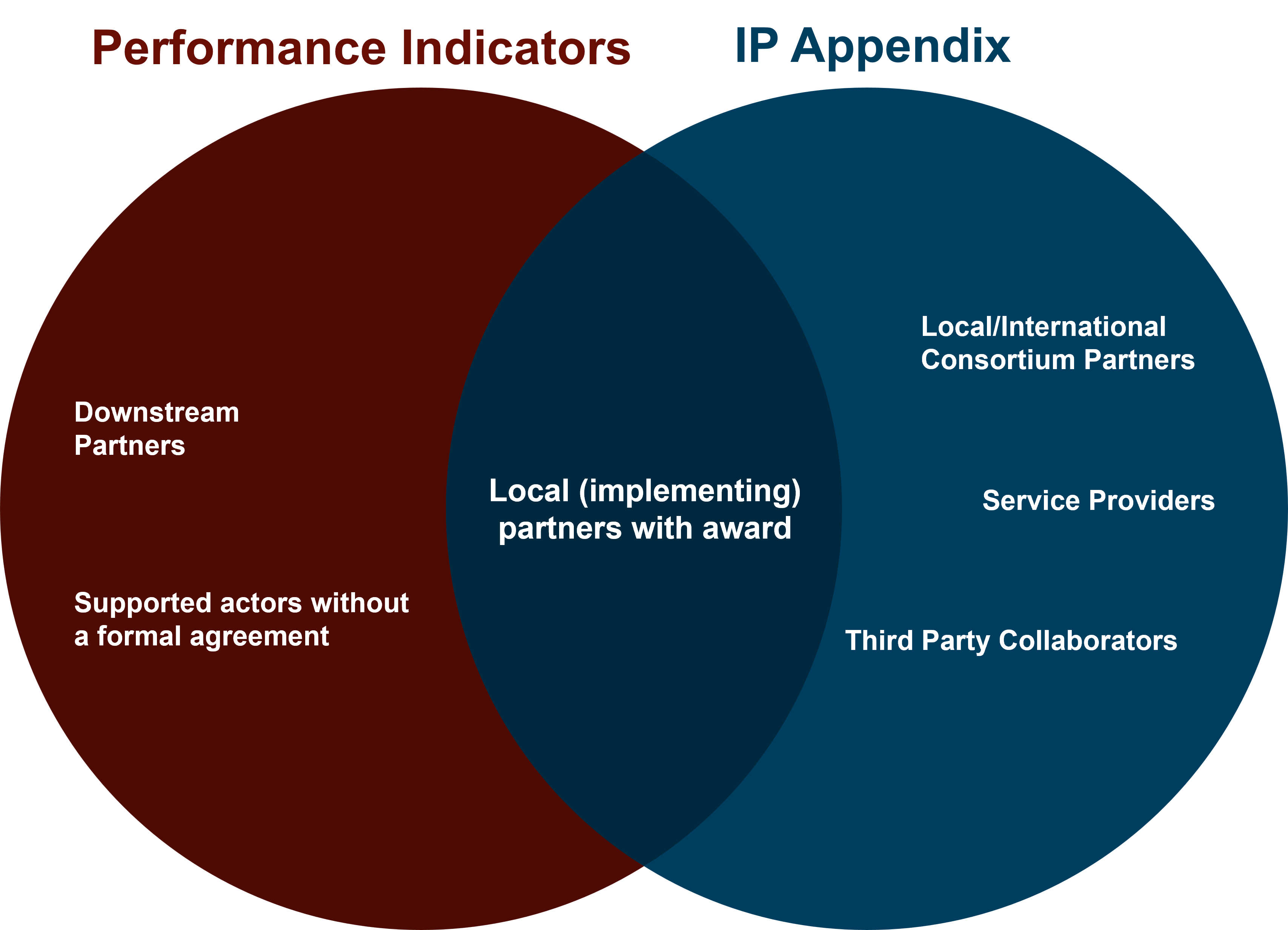
These two reporting elements serve different purposes. Understanding how to categorize our collaborators correctly will ensure consistency and clarity in our reporting. At the end of this chapter, you'll find a visual graph that illustrates which types of collaboration and support should be reported under which reporting format.
Annual Reporting IP Appendice
The IP Appendix is where we list all institutional collaborators that a project formally works with. This includes different types collaboration as thsipaly in this matrix categorized by:
Type of collaboration
Sector
It’s important to note that not every institutional collaboration is a “partnership”. A partnership usually involves an equitable, long-term relationship, where both parties share common goals. However, many collaborations are more functional or service oriented
There are two main types of institutional collaborators that must be included in the IP Appendix each year: a) Project Partners and b) Service Providers. The other two categories listed in the matrix, Alliances and Grants, are not part of the reporting. However, they are part of the matrix to help you better understand which types of collaborations are not considered project partners.
Project Partners
These are organizations that directly contribute to achieving project outcomes. They usually implement activities and may receive funding or technical support from Helvetas. Project partners fall into three main categories:
Local (Implementing) Partners: These are local organizations with whom Helvetas has a formal agreement, usually a Partnership Agreement including direct funding or support (and sometimes sub-awards). The partner carries out project activities and, in doing so, is also strengthened institutionally.
Consortium Partners: These are partners involved in joint project implementation, usually through a Bid Agreement (Consortia and Subcontracting). Such arrangements are often made for large tenders or complex projects. A consortium can include international or local organizations and may be structured in various ways. The relationship is more strategic.
Third-Party Collaborator: These are organizations, such as government ministries, district offices, or academic institutions, with whom Helvetas has a Memorandum of Understanding (MoU). The collaboration is formalized, but no funds are exchanged. Both parties may contribute time, resources, or expertise, but the relationship is non-contractual and does not involve implementation of project activities by the third party (often a ministry or public institution)..
Service Providers
Service providers are typically contracted individuals or organizations who deliver specific goods or services to the project. The relationship is based on a service contract, not a partnership. These providers are paid for their services (e.g. training delivery, research, construction, etc.), but the goal is not to strengthen them as actors. Even though their work may contribute to development outcomes, they are not considered “project partners” because we do not intentionally build their capacity as part of the project
Annual Reporting: Performance Indicators
Supported Actors
In our project reporting, we refer to “supported actors” when we work with and strengthen groups, organizations, institutions, or individuals who contribute to achieving the project’s objectives. These actors can include civil society organizations, community groups, local governments, academic institutions, or micro, small and medium-sized enterprises (MSMEs). They may be involved in or influence a process, system, or specific outcome of the project.
Supported actors are those who have benefitted from the project either directly through Helvetas or indirectly through our implementing partners. This support can include capacity development, financial assistance, or in-kind contributions such as equipment, training, or materials. It is not necessary for Helvetas to have a direct contract with these actors, they can still be counted if support flows to them through our partners and is waht we refer to as a downstream partner. They can be a local organization or actor that is supported by one of Helvetas’ local implementing partners. While Helvetas may not have a direct agreement with the downstream partner, they still receive funding, training, or other support as part of the project. In that sense, they are also primary stakeholders and play an important role in achieving the development objectives.
These actors are reported under partner performance indicators, which typically begin with: “Number of civil society, public, or private actors supported to…” This helps us measure the reach and effectiveness of our interventions beyond individual people.
What is part of this reporting
Here we report all:
All local implementing partners who receive formal support or funding through a grant, contract, or other agreement. These are also part of the insitutional collaborators to to be reported in the IP Appendix.
All local actors, institutions, or downstream partners that receive support from our implementing partners.
Any other organization, institution, or group that has received some form of capacity strengthening, financial, or in-kind support from the project, even if there is no formal agreement in place with Helvetas.
What is NOT part of this reporting
Not every collaborator is considered a supported actor. The following should not be reported under our partner perforamnce indicators:
Service providers, such as trainers or consultants
Consortium partners, with whom we implement projects jointly
Third-party collaborators, who contribute expertise, influence or resources
These actors are important to the project, but Helvetas’ objective is not to build their capacity. Therefore, they are not included in the partner performance indicators.
How to report
If an actor was supported in a previous calendar year and continues to receive support this year, do not count them again. Only newly supported actors should be reported each year. This follows the same cumulative logic used for the People Output Indicators.

Each supported actor should be counted once. Do not count the number of individuals within the organization. If an institution has several divisions or departments and the support provided to each is clearly distinct and contributes to different outcomes, you may count each division as a separate actor.
MSMEs or businesses that are supported as part of private sector development (PSD) interventions should not be reported as supported actors. Instead, they must be reported under the relevant PSD indicator: PSD 2.3.1 Businesses making use of financial products and services
Difference of the two reporting formats